


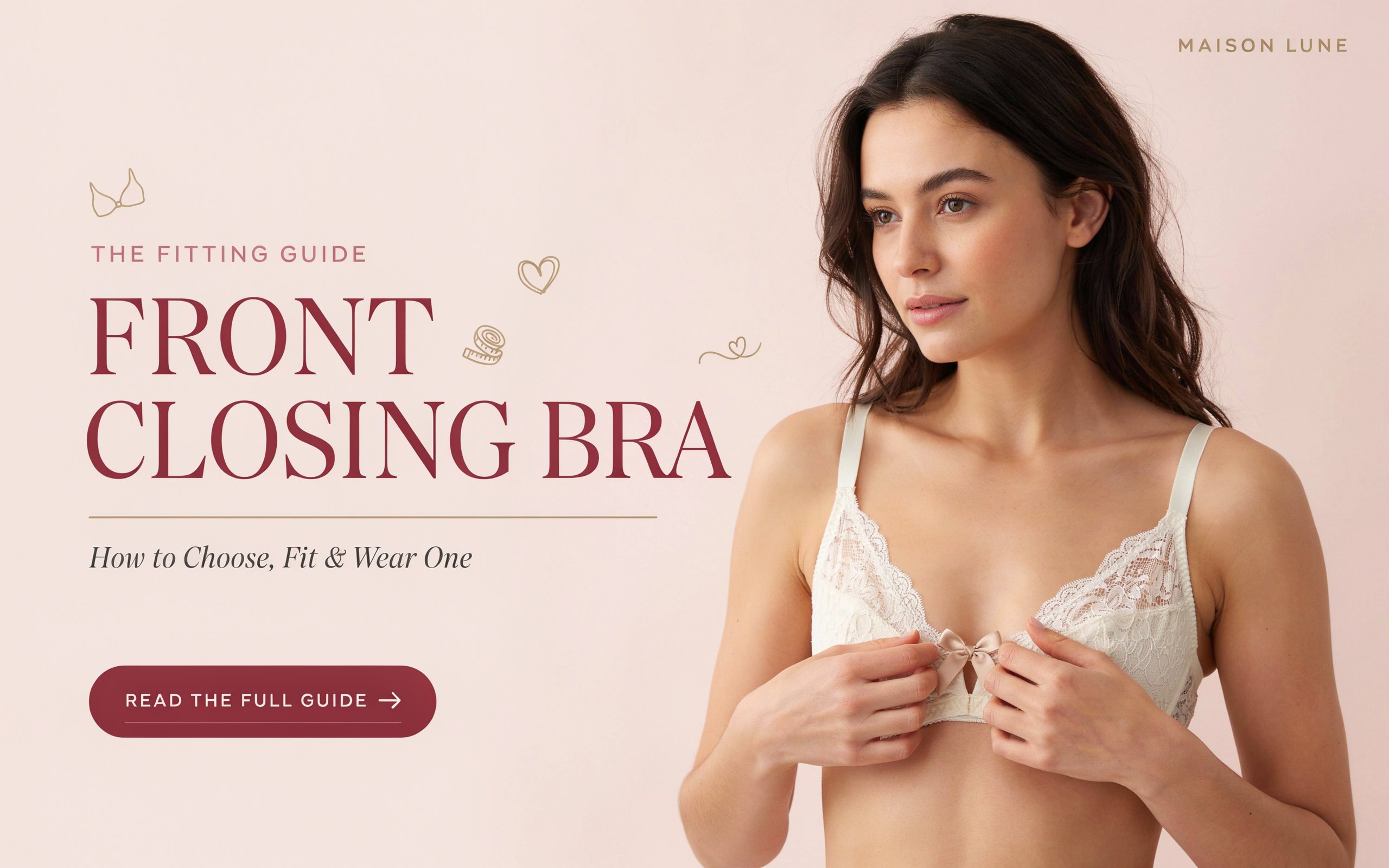
Anyone who has twisted their arms behind their back to fight with bra hooks knows how annoying a back clasp can be. A front closing bra moves the fastening to the center, so you can put it on in seconds without any contortions. It also gives you a smooth back, which is a bonus under fitted tops like the ones in our black shirt styling guide.
In this guide you’ll learn what a front closing bra is, how it compares with a back closure bra, the pros and cons, the main types of clasps and styles, how to pick the right size and clasp, and how to keep it in good shape for longer. By the time you finish reading, you’ll know exactly what to look for before you buy.
What Is a Front Closing Bra?
A front closing bra is a bra that fastens at the center, between the cups, instead of at the back. It’s also called a front closure bra, front clasp bra or front opening bra. You open it by releasing the clasp at the front, and you close it by joining the two sides again. These terms all mean the same thing. The closure can be a hook-and-eye, a snap clasp, a zipper or a magnetic fastening, depending on the style.
If you want another overview of how these bras work, Debra’s has a handy guide to front opening bras.
Front Closing Bra vs Back Closure Bra
Neither style is better for everyone. Here’s how they usually compare.
Ease of Use
A front closing bra is much easier to put on and take off, especially if you have limited shoulder movement or find back hooks fiddly. You can fasten it in front of you and see exactly what you’re doing.
Support and Adjustability
Back closure bras usually have several rows of hooks, so you can adjust the band as it stretches. Many front closing bras don’t have a band adjustment, so getting the right band size from the start matters more.
Look Under Clothes
Without back hooks, the back of a front closing bra is smooth. That gives you more choice of back styles, including racerback, T-back and lace backs, and nothing shows through thin tops. On the other hand, the front clasp can sometimes be visible under very tight or thin fabric.
Benefits of a Front Closure Bra
- Easy to wear: great if back hooks are hard to reach or fasten.
- Smooth back: no row of hooks to dig in or show under tops.
- Back style options: racerback and T-back versions are common.
- Good with low necklines: the center clasp sits at the front of the bra and works under many low-cut tops.
- Convenient for travel and the gym: quick on and off.
Many people choose them because shoulder mobility or hand strength makes back hooks difficult. If you’re recovering from surgery, ask your doctor or surgeon what kind of bra is recommended.
Downsides to Know About
- Narrow center panel: the area between the cups is often smaller, which can affect the fit if your bust is close together or far apart.
- Clasp can pop open: this often means the band size is wrong, since a band that’s too small puts pressure on the closure.
- Limited band adjustment: you can’t loosen or tighten the band as it stretches.
- Visible clasp: it can show under very thin or tight tops.
Types of Front Closing Bras
By Clasp Type
The clasp makes a big difference to comfort and support.
- Hook-and-eye: works like a back closure and generally gives more support than a single clasp.
- Snap clasp: a single plastic or metal clasp that’s quick to open and close.
- Zipper: common in sports bras for a secure feel.
- Magnetic: the magnets guide the clasp together, which can help if small fasteners are difficult.
By Bra Style
- T-shirt bra: smooth cups that disappear under tops.
- Wireless or soft cup: comfortable for long days or lounging.
- Sports bra: a front zip or clasp for workouts. Easy to take on and off after exercise.
- Lace or bralette: lighter, more decorative styles.
How to Choose a Front Closing Bra
Check these five things before you buy a front closing bra.
Get the Band Size Right
Because many front closing bras don’t have an adjustable band, the band needs to fit well from day one. The band should hold firmly around your ribcage without squeezing, and sit flat all the way round
Check the Clasp Strength
The clasp holds the whole bra together, so look for a sturdy one that closes with a clear click. A weak clasp can slip or break.
Look at the Center Panel
The center panel should lie flat against your chest. If it floats away from your body, the cups may be too small or the style may not suit your shape.
Choose a Back Style
If you wear open-back tops, a racerback or T-back style will keep the straps hidden. For everyday wear, a standard back works well.
Pick a Comfortable Fabric
Soft cotton, modal and bamboo blends feel good against the skin, while smooth microfiber gives a clean line under clothes.
How a Front Closing Bra Should Fit
- Fasten the clasp comfortably. It should close without straining.
- Check the band. It should sit level, not ride up toward your shoulder blades.
- Check the cups next. Your breasts should sit fully inside them, with no bulging over the top and no empty spac
- Adjust the straps. They shouldn’t dig in or slip off.
- Move around. Raise your arms and bend over. The clasp should stay closed.
If the clasp keeps popping open, try a larger band size or a style with a hook-and-eye closure.
How to Wear a Front Closing Bra
This style works with most outfits. For low-cut and V-neck tops, the center clasp sits in the middle of the bra, so it’s usually easy to hide. For open-back tops and dresses, choose a racerback or T-back style. Under fitted tees, pick a smooth, seamless cup so the clasp and edges don’t show.
How to Care for a Front Closing Bra
- Fasten the clasp before washing so it doesn’t snag other fabrics.
- Wash gently by hand or in a mesh bag on a delicate cycle.
- Air dry flat, and avoid the dryer, since heat can damage elastic.
- Rotate between a few bras so each gets time to recover.
- Check the clasp regularly, and replace the bra if it loosens or bends.
Common Front Closing Bra Mistakes to Avoid
- Buying the wrong band size. This is the main reason the clasp pops open.
- Choosing a weak clasp for a full bust. Go for a hook-and-eye or a sturdy clasp for extra support.
- Ignoring the center panel. A gap here means the fit isn’t right.
- Wearing a worn-out bra. A stretched band or loose clasp stops providing support.
- Skipping the fit check. Try it on and move around before deciding.
Frequently Asked Questions
What is a front closing bra?
A front closing bra is a bra that fastens at the center, between the cups, instead of at the back. It’s also called a front closure, front clasp or front opening bra.
Are front closure bras supportive?
Yes, many are. Hook-and-eye styles tend to give more support than single clasps, so choose based on your bust size and whether you prefer underwire.
Why does my front clasp keep popping open?
Usually the band is too small or the clasp is weak. Try a bigger band size or a sturdier closure.
Can I wear a front closing bra under low-cut tops?
Yes. The clasp sits at the center of the bra, so it’s easy to hide under most low-cut and V-neck styles.
Is a front closing bra the same as a nursing bra?
No. A front closing bra fastens at the front for easy dressing, while a nursing bra has cups that open for feeding. Some bras combine both features.
Final Thoughts
A front closing bra makes getting dressed easier and gives you a smooth back, as long as you choose the right size and a secure clasp. Check the band, the center panel and the closure type, and you’ll find a style that feels comfortable all day.
Try one on this week, and tell us in the comments what you think. Save this guide to your style board on Pinterest so you can find it when you shop. For more outfit ideas, take a look at our pink blazer styling guide and our polka dot skirt guide.